
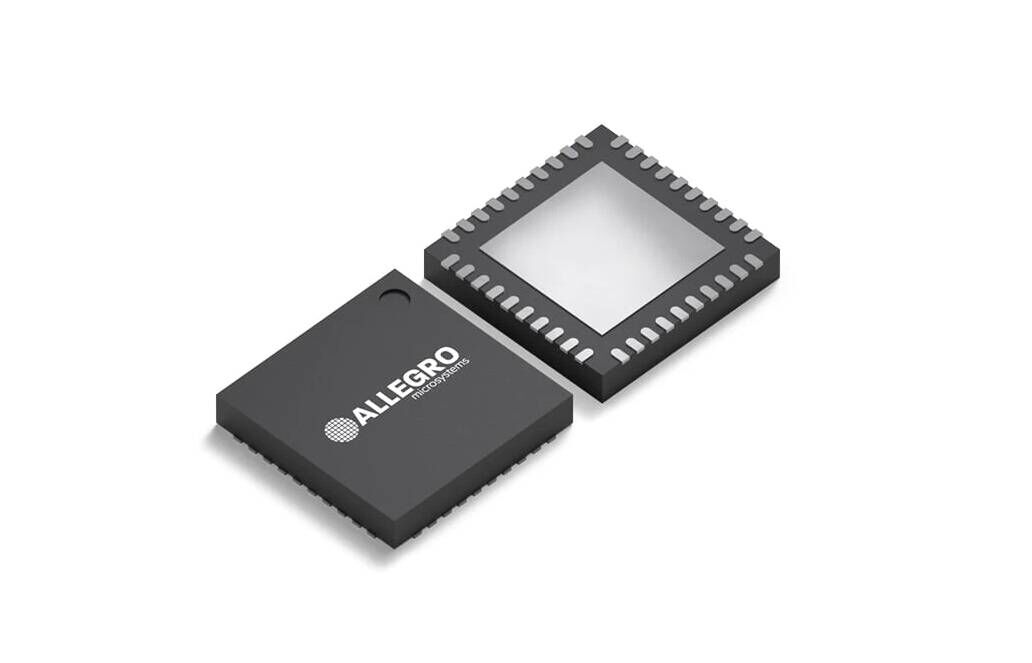

August 3, 2026 / SemiMedia / — Allegro MicroSystems has introduced the A81415 automotive safety power-management IC, integrating a wheel-speed sensor interface, power regulation and functional-safety capabilities in a single device.
The product targets electromechanical braking and brake-by-wire systems, where power conversion, sensing, communication and safety monitoring must operate within compact electronic modules installed close to each wheel.
Allegro describes the A81415 as the industry’s first ASIL-D-certified PMIC to integrate a wheel-speed sensor interface.
Software-defined vehicle architectures are moving more computing functions into domain controllers and centralized processors. However, brake actuators must still operate at the vehicle’s wheels.
Electromechanical braking corner modules consequently require local power supplies and accurate wheel-speed data while operating under vibration, temperature changes and automotive electrical transients.
Existing designs may combine a general-purpose safety PMIC, a separate wheel-speed decoder and multiple discrete power components. This increases component count, consumes PCB area and creates additional points that must be considered during safety analysis and system validation.
The A81415 includes an on-chip wheel-speed sensor interface capable of decoding standard two-level, two-level pulse-width-modulation and three-level AK protocols, including standard- and high-resolution modes.
The integrated interface removes the need for a separate decoder IC and its associated analog signal-conditioning circuitry.
After processing the physical layer internally, the A81415 sends decoded wheel-speed information to the microcontroller through a Serial Peripheral Interface.
Allegro said this arrangement can shorten the signal-processing path in the safety-critical braking loop and reduce the amount of MCU bandwidth required for low-level wheel-speed decoding.
The power-management section incorporates a buck-boost pre-regulator, five low-dropout linear regulators and a single-inductor architecture that does not require external power switches or diodes.
Each internal linear regulator includes foldback short-circuit protection.
The A81415 has an operating input-voltage range of 3.2V to 36V and a maximum input rating of 40V, allowing it to operate directly in conventional 12V automotive electrical systems.
According to Allegro’s design estimates, the integration can eliminate as many as nine external components and reduce semiconductor bill-of-materials cost by up to $4 per vehicle.
The company also said the device can free more than 50% of the usable board space previously occupied by the relevant power, decoding and discrete components.
Actual savings will depend on the original power architecture, wheel-speed interface configuration, external protection requirements and individual OEM design specifications.
Low-noise output rails are optimized to power Allegro XtremeSense tunneling-magnetoresistance angle sensors.
These sensors can support motor-commutation position and caliper clamping-force measurements, allowing the PMIC, wheel-speed interface and actuator-position sensing functions to operate as a coordinated signal chain.
For functional safety, the A81415 includes dual watchdogs, internal fault handling and other integrated monitoring functions.
The device was developed as a hardware safety element out of context with ASIL-D capability and is qualified to AEC-Q100 Grade 0 for operation in demanding automotive temperature environments.
A 48V corner module requires an additional high-voltage input stage. Allegro proposes pairing the A81415 with its APM81815 pre-regulator and 48V gate drivers.
The APM81815 is an 80V, 1.5A synchronous buck regulator with a 5V-to-72V operating input range and selectable 3.3V, 5V, 5.35V or 12V outputs.
It can convert the vehicle’s 48V bus to a lower intermediate supply for the A81415 and associated braking electronics.
This modular architecture gives Tier 1 suppliers a path to adapt existing 12V brake-control designs for future 48V corner modules while limiting changes to the input power and transient-protection stages.
The A81415 reflects a broader trend toward application-specific automotive ICs that combine power management, safety monitoring and sensor interfaces previously implemented with separate components.
Lower component count can help reduce module size, simplify routing and decrease the number of electrical interconnections within a brake actuator.
Single-chip integration does not eliminate the need for system-level redundancy. Final brake-by-wire implementations must still address independent power domains, communication paths, actuator supervision, mechanical fallback strategies and fault-response requirements according to the vehicle’s safety concept.
Samples and evaluation support for the A81415 are available from Allegro. The principal target applications include electromechanical brake actuators and brake-by-wire corner modules.









All Comments (0)