
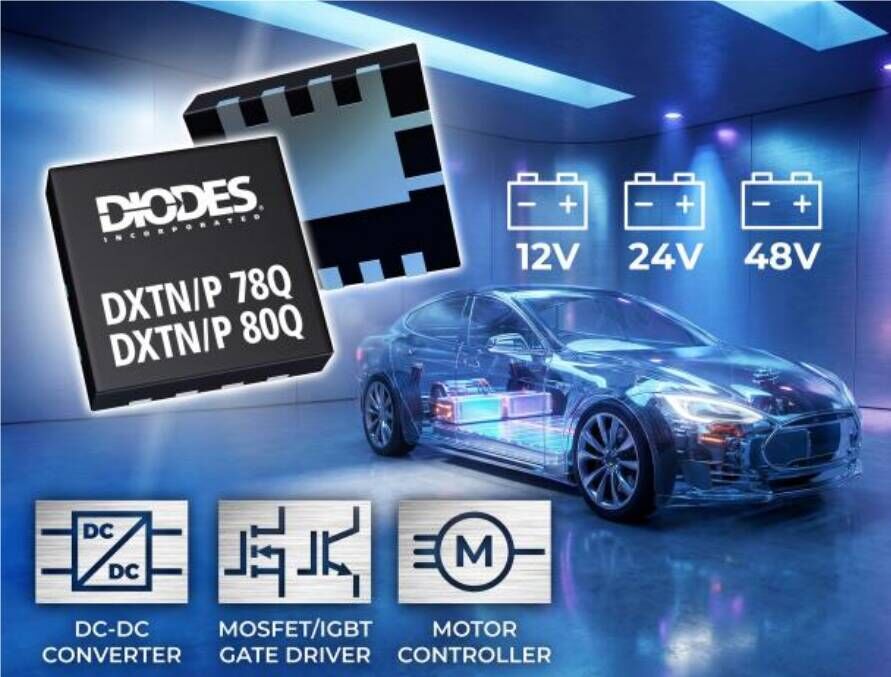

December 22, 2025 /SemiMedia/ — Diodes Incorporated has expanded its portfolio of automotive-qualified bipolar transistors, targeting power switching and control applications as vehicle electronics move toward higher power density and harsher operating conditions.
The newly introduced DXTN/P 78Q and 80Q series include both NPN and PNP devices optimized for low saturation voltage and improved thermal performance. The products cover BVCEO ratings from 30 volts to 100 volts, enabling use across 12V, 24V and 48V automotive electrical architectures.
The devices are designed for a wide range of automotive power and control functions, including MOSFET and IGBT gate driving, power line and load switching, low-dropout regulation and DC-DC conversion. They are also suited for driving motors, solenoids, relays and actuators. With continuous operation rated up to 175 degrees Celsius and enhanced ESD robustness, the transistors are intended to support reliable operation in demanding automotive environments.
Compact packaging and thermal design reshape PCB efficiency
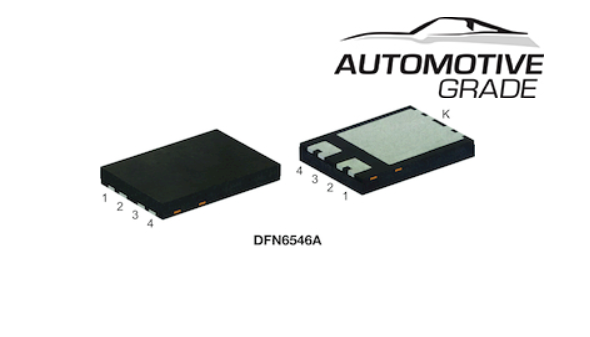
Packaged in Diodes’ PowerDI®3333-8 format, the devices significantly reduce PCB footprint compared with traditional SOT223 packages, freeing board space for additional system functions. A large underside heatsink helps achieve low thermal resistance, while the side-wall plateable design improves automated optical inspection and solder joint reliability in high-volume manufacturing.
Higher current capability supports next-generation vehicle power systems
Within the lineup, the DXTN/P 80Q series targets higher current applications, offering continuous current capability of up to 10 amps and peak pulse ratings of 20 amps. Ultra-low saturation voltage and low on-state resistance help reduce conduction losses by as much as 50% versus earlier generations, enabling cooler operation and simplified thermal management.
Diodes said the automotive-qualified devices are now available to customers, alongside standard compliance versions of the 78 and 80 series intended for industrial and commercial applications.





All Comments (0)