
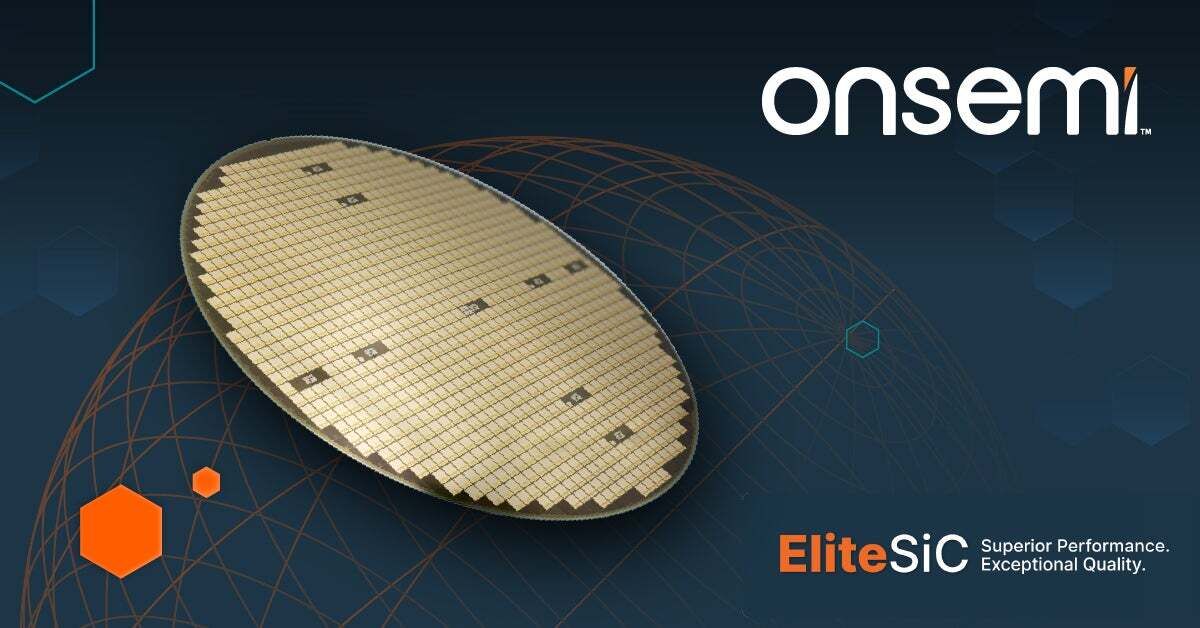

November 12, 2026 / SemiMedia / — onsemi has introduced EliteSiC M4, its fourth-generation silicon carbide platform, moving from the planar MOSFET structures used in earlier generations to a trench architecture. The company reports up to 30% higher power density and 35% lower losses versus the previous generation, targeting electric vehicle traction inverters, AI data center power conversion and energy infrastructure.
The platform reduces specific on-resistance by 20% to 50%, improving conduction performance while enabling faster switching. A lower specific on-resistance gives designers scope to reduce the chip area needed for a given resistance target or increase current capability within an existing footprint.
onsemi reports improvements in switching figures of merit of 67% under hard-switching conditions and 50% under soft-switching conditions. These figures describe device performance metrics rather than equivalent percentage reductions in converter losses.
In a supporting white paper, the company attributes part of the switching improvement to reduced reverse transfer capacitance, or Crss. This reduces the Miller effect, enabling faster voltage transitions and less energy dissipation during switching. Designers can use lower switching losses to raise switching frequency and reduce passive-component size, or retain the existing frequency to improve efficiency and ease cooling requirements.
The architecture also addresses gate-oxide reliability and short-circuit ruggedness. onsemi says platform qualification supports temperatures of 185 degrees Celsius and above. Product-specific temperature ratings and operating limits remain subject to the relevant device specifications.
EliteSiC M4 is designed to support existing packaging formats, including top-side-cooled surface-mount packages and high-power modules. This gives system designers options for integrating the technology into compact power supplies and traction inverters, where electrical performance, heat removal and package layout must be considered together.
The first offering, a 750 V bare die for automotive traction inverters, is available now. Additional products covering voltage ratings up to 1200 V are expected to become available beginning in 2027, extending the platform across a wider range of high-voltage power-conversion applications.






All Comments (0)