
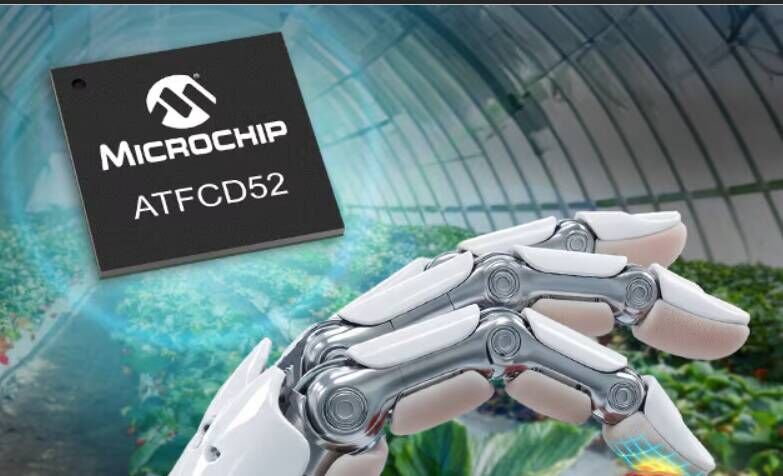

November 17, 2026 / SemiMedia / — Microchip Technology has introduced the ATFCD52 high-speed capacitance digitizer for robotic grippers and dexterous humanoid hands. Announced on November 10, the device converts signals from two-dimensional capacitive sensor arrays into digital data that an external processor can use to calculate normal and shear forces.
The ATFCD52 supports up to 52 electrode channels, with up to 32 transmit lines and 20 receive lines. That configuration accommodates up to 640 sensing nodes. Twenty parallel analog front ends acquire all receive lines simultaneously, helping capture changes across the contact surface.
Microchip specifies frame rates of up to 800 Hz for a 10 × 10 matrix, with acquisition speed dependent on array size. Faster tactile updates can help a robotic control system detect the onset of slip and adjust gripping force while handling fragile or irregular objects.
The device is designed to resolve capacitance changes below 1 femtofarad, allowing it to detect small deformations in soft sensor materials. Frequency hopping and oversampling help reduce interference from servo motors, power electronics and switching regulators, where electrical noise can obscure small contact signals.
System designers can pair the digitizer with an MCU, MPU or FPGA according to processing requirements. The host processes the array data to derive contact forces and support grip control, while the ATFCD52 handles capacitance acquisition and digitization.
For evaluation, Microchip offers the EV-ATFCD52 kit with a 10 × 10 sensor and an 80-way FPC/FFC connection for custom arrays. The ATFCD Configurator plug-in for maXTouch Studio supports configuration and tuning, with real-time visualization and data logging to evaluate sensor materials and mechanical stack-ups. The kit’s USB bridge supports I²C configuration and SPI frame-data capture.
The ATFCD52 is in production and can be purchased through Microchip and its authorized distribution network. Other target applications include AR and gaming accessories, data-collecting gloves and foot mats, and wearable electronic skin.





All Comments (0)