
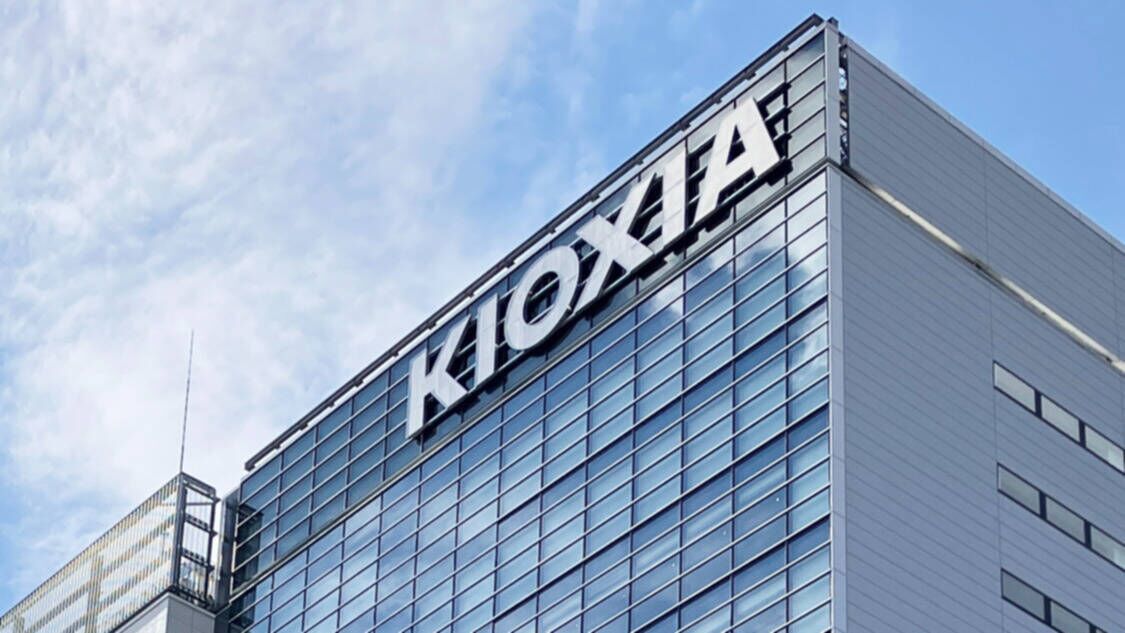

July 3, 2026 /SemiMedia/ — Kioxia is preparing to begin mass production of its 10th-generation BiCS Flash at its Kitakami plant in Iwate Prefecture, Japan, as demand for high-capacity NAND Flash rises with the expansion of artificial intelligence applications.
The next-generation BiCS Flash technology was developed in cooperation with SanDisk and is expected to support data centers, AI servers, enterprise SSDs and other high-capacity storage systems that require better performance, lower power consumption and greater density.
During the early stage of the AI boom, investor attention focused mainly on DRAM and high-bandwidth memory, particularly because HBM is critical for AI accelerator training workloads. However, as AI moves from large-scale training into inference, demand for storage is also increasing.
AI inference requires fast access to models, retrieval systems, vector databases and large volumes of user and enterprise data. This is raising the importance of NAND Flash in AI infrastructure, especially for high-capacity SSDs and low-latency storage systems.
Industry observers said several memory makers prioritized investment and R&D in DRAM and HBM over the past few years, leaving NAND investment relatively limited. As AI inference and enterprise storage demand accelerate, high-performance NAND supply has tightened, bringing renewed attention to suppliers with advanced NAND technology and mass production capability.
Kioxia’s recovery also reflects a broader shift in the NAND market. The company, formerly Toshiba Memory, traces its roots to the invention of NAND Flash in the 1980s. In 2018, a Bain Capital-led consortium acquired the memory business from Toshiba for about 2 trillion yen.
The company was later hit by falling memory prices, which delayed its listing plans until late 2024. More recently, however, AI-driven storage demand has improved market sentiment toward Kioxia, with investors increasingly focused on its NAND technology, enterprise SSD business and role in AI storage supply.
Analysts said Kioxia has advantages in NAND Flash performance and power consumption, supported by technologies such as wafer bonding. These capabilities could help the company strengthen its position in high-end NAND and AI data center storage as 10th-generation BiCS Flash enters production.
From an industry perspective, AI is driving demand across HBM, DRAM and NAND. Training workloads depend heavily on HBM and server DRAM, while inference workloads are increasing demand for high-capacity SSDs, low-latency storage and reliable data access systems.
As AI services are deployed at larger scale, NAND Flash could become a more important growth driver in the memory market after HBM.


All Comments (0)