

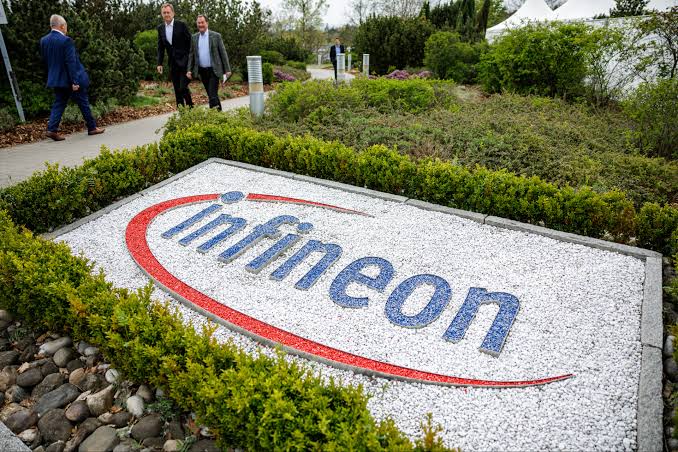
July 3, 2026 /SemiMedia/ — Infineon Technologies has officially opened its new €5 billion smart power semiconductor fab in Dresden, Germany, marking a major step in Europe’s effort to strengthen domestic chip manufacturing capacity.
The facility was completed about three months ahead of schedule and represents one of the largest single investments in Infineon’s history. The new fab will produce chips for intelligent power management, as well as analog and mixed-signal technologies.
These chips are used in electric vehicles, wind turbines, solar power systems, industrial equipment, software-defined vehicles and power infrastructure for AI data centers.
Infineon Chief Executive Officer Jochen Hanebeck said the smart power fab is creating urgently needed capacity for key future technologies, ranging from AI data center energy supply to renewable energy and software-defined cars.
The new facility doubles Infineon’s production capacity in Dresden and strengthens the site’s position as one of the world’s largest manufacturing bases for power semiconductors and analog/mixed-signal technologies. The company said the project will create about 1,000 direct jobs.
The fab received support under the European Union’s Chips Act, including about €1 billion in subsidies. The EU aims to raise Europe’s share of global semiconductor production from about 10% to 20% by 2030.
German Chancellor Friedrich Merz said the new facility has strategic importance for digital sovereignty, economic resilience and supply chain independence. As investment in AI data centers continues to grow, power semiconductors are becoming increasingly important for energy transition, future mobility and AI infrastructure.
Infineon said the Dresden fab uses a highly digitalized and automated manufacturing system. The building and equipment layout were planned and optimized using digital twin technology, while artificial intelligence algorithms support system and process approvals.
The new fab is also connected with Infineon’s Villach site in Austria through a virtual integrated manufacturing model, allowing faster process and product validation.
The chips produced in Dresden will help improve power conversion and energy management. Smart switches, for example, can control electrical loads while also monitoring current flow. The combination of power semiconductors and analog/mixed-signal components enables more energy-efficient system-level solutions.
Infineon also said the facility sets new standards for sustainable manufacturing. The production system does not use natural gas, while water treatment and closed-loop water systems reduce water consumption. About 90% of water used at the site can be recycled, enabling energy recovery of up to 45%.


All Comments (0)