

SemiMedia SemiMedia
  • Breaking News
  • MarketWatch
  • Distribution
  • Manufacturer
  • Video
  • About us
Home › Manufacturer › ROHM’s LAPIS Semiconductor develops world’s smallest wireless power supply chipset
  • 0

ROHM’s LAPIS Semiconductor develops world’s smallest wireless power supply chipset

SemiMediaEdit
April 26, 2018

ROHM Group's LAPIS Semiconductor develops the world's smallest wireless power supply control chipset "ML7630 (receiver/terminal)" and "ML7631 (transmitter/charger side)" for wearable devices.

The chipset is a wireless power supply control LSI that is suitable for wireless power supply of smart ear-mounted devices such as Bluetooth® headsets that have space limitations in wearable devices. In order to support applications in smart ear-worn devices, LAPIS Semiconductor miniaturizes the antenna (coil) by performing power transmission at a high frequency of 13.56 MHz, and integrates the functions required for charging into one chip. It is used as a SoC, which greatly reduces the installation space (50% compared to the area of ​​the Micro USB connector). The wireless power supply of smart ear-worn devices, which was difficult to achieve in the past, now it not only contributes to the miniaturization of the devices, but also helps to improve the convenience, waterproofness, and dust-proofness of charging.
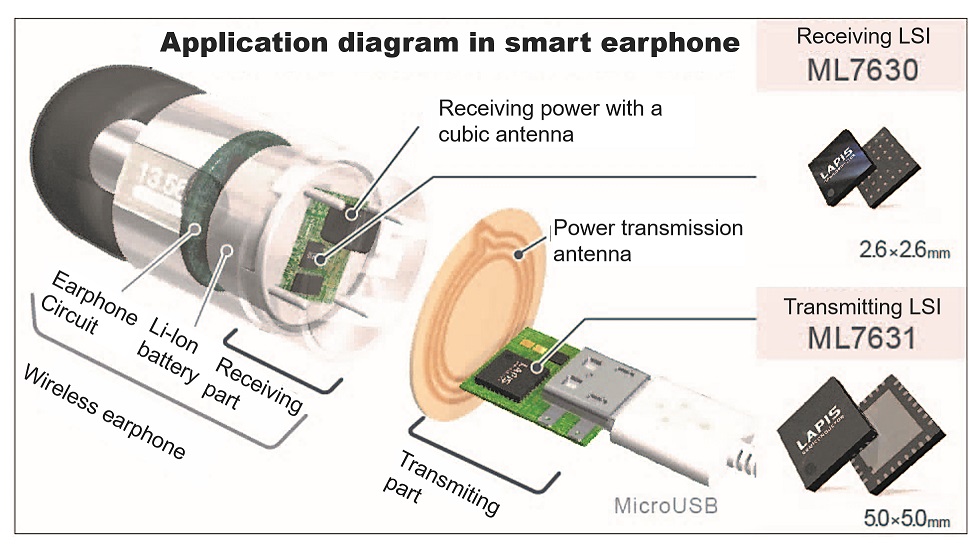
ROHM’s LAPIS Semiconductor develops world’s smallest wireless power supply chipset-SemiMedia

Even if the battery is exhausted, the receiver's “ML7630” can use the antenna magnetic field to generate electricity and start working. In addition, although it is a small WL-CSP package of only 2.6mm square, it achieves wireless power supply with output power up to 200mW. Furthermore, it also meets the NFC Forum Type3 Tag v1.0 standard and supports functions such as Bluetooth® pairing based on NFC. Moreover, the transmitter's “ML7631” can work with 5V power provided by USB power sources such as mobile phone batteries, which is very beneficial to the development of mobile chargers.

The chipset is expected to begin mass production in May 2018. The production of the previous process is the LAPIS Semiconductor Miyagi Factory, and the production process of the later stage "ML7630" is the LAPIS Semiconductor Miyazaki Factory.

Related

Lapis ML7630 ROHM
Bourns introduces five new SinglFuse film products
Previous
MTK launches ASIC business
Next

All Comments (0)

Back
No Comment.

Top Post

Mouser Electronics expands to the Philippines with local customer service center
Fire broke out at AKM factory in Japan
Qualcomm ranked first in the world's top ten IC design companies
Analyze the key factors and prospects of electronic components shortage from the perspective of wafer industry
TSMC’s CoWoS capacity to reach 75,000 wafers/month by end-2025
onsemi expects to produce 200mm SiC wafers by 2025

Subscribe SemiMedia

Please check your E-mail to confirm the subscribtion.

Related posts

SK hynix says memory market turns seller-driven, prices seen rising through 2026

SK hynix says memory market turns seller-driven, prices seen rising through 2026

February 24, 2026
0
Infineon rolls out isolated gate drivers to support next wave of SiC power systems

Infineon rolls out isolated gate drivers to support next wave of SiC power systems

February 12, 2026
0
ST launches Stellar P3E automotive MCU with on-chip AI acceleration for SDV platforms

ST launches Stellar P3E automotive MCU with on-chip AI acceleration for SDV platforms

February 11, 2026
0
TDK rolls out stackable µPOL modules targeting AI server and ASIC power delivery

TDK rolls out stackable µPOL modules targeting AI server and ASIC power delivery

February 9, 2026
0
Copyright © 2017-2026 SemiMedia. Designed by nicetheme.
  • Please set up your first menu at [Admin -> Appearance -> Menus]
  • electronic components news
  • Electronic components supplier
  • Electronic parts supplier
  • Infineon
  • Electronic component news
  • Renesas
  • Vishay
  • STMicroelectronics
  • NXP
  • TDK

SemiMediaEdit

Administrator