
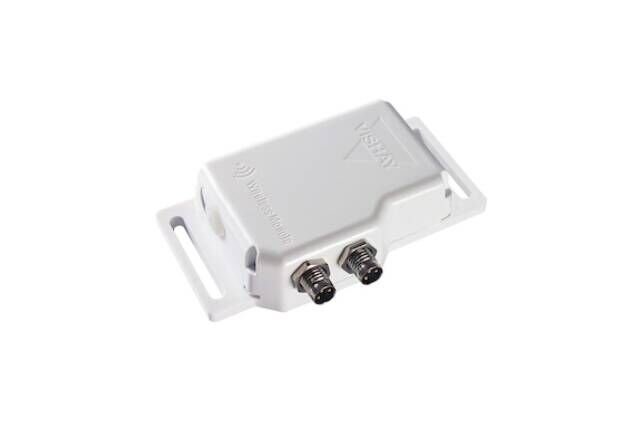

November 27, 2026 / SemiMedia / — Vishay Intertechnology has introduced the Sfernice WLMO, a battery-powered wireless module that connects up to two analog position sensors to industrial monitoring systems. Operating in the 2.4 GHz ISM band, the module targets actuator monitoring, condition-based maintenance and other applications requiring periodic position data.
The WLMO supplies power to the sensors, digitizes their signals through an internal 12-bit ADC and sends measurements to a customer’s receiver or gateway for host processing. It supports potentiometric and contactless sensors, provides sensor supplies up to 5 V and uses sealed M8x1 three-pole connectors.
The node uses a proprietary protocol over LoRa modulation on a private network. Customers must implement the protocol in their receiving system. Bidirectional communication enables remote configuration, while AES128 encryption protects transmitted frames. A sealed mechanical switch handles initial activation and pairing.
Radio settings include five selectable channels within the 2.4 GHz band, each with a bandwidth of ±200 kHz, and spreading factors from SF7 to SF12. Specified transmit power is 7.08 mW, or 8.5 dBm, with receiver sensitivity of −140 dBm. Communication range reaches up to 2 km at SF12 in an unobstructed open field with optimal module and gateway orientation.
Power comes from two replaceable 1.5 V AAAA batteries rated at 625 mAh. Typical battery life of two years is specified at SF7 with one measurement every 15 minutes and one transmission per hour. Battery voltage is included in transmitted data to support maintenance planning.
Developers can configure the reporting interval and the number of measurements taken between transmissions. The transmitted sensor voltage represents the average of those measurements. This allows reporting frequency and sampling to be adjusted for slowly changing equipment positions, agricultural installations and other distributed monitoring applications.
The module measures 89 mm × 55.5 mm × 21.6 mm and operates from −18 °C to +55 °C. Its IP67 enclosure uses UV-resistant material compliant with ISO 4892-2.
Samples and production quantities are available now, with a lead time of 14 weeks.






All Comments (0)