
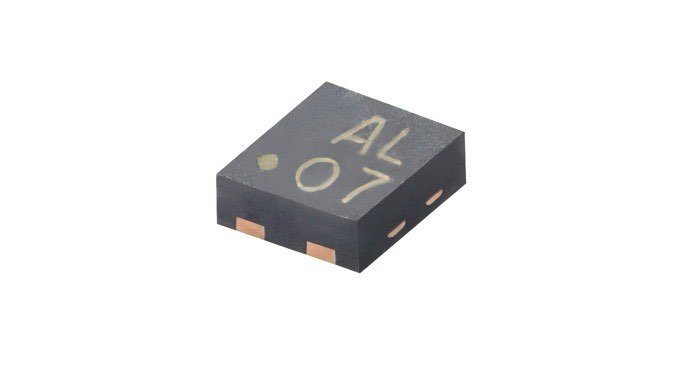

May 4, 2026 /SemiMedia/ — Murata Manufacturing Co., Ltd has begun mass production of its MRMS166R and MRMS168R anisotropic magnetoresistance (AMR) sensors, targeting healthcare devices, wearables and IoT applications.
The MRMS166R is designed for ultra-low power operation, drawing an average current of about 20 nA at 1.2 V. This allows longer battery life in small systems that rely on coin-cell batteries, which are commonly used in compact electronics.
The devices function as solid-state magnetic switches, detecting changes in magnetic fields and sending signals to control system states such as sleep and active modes. This replaces mechanical switches and helps improve reliability while supporting smaller and sealed product designs.
These types of sensors are widely used in low-power devices that need automatic power management. Applications include capsule endoscopes, medical patches, AR glasses, wireless earbuds, and IoT security devices such as smart locks and door sensors.
Most of these systems use silver oxide coin batteries, which have limited capacity and voltage range. Murata said it optimized the internal circuit design to reduce power consumption and ensure stable operation down to 1.2 V, extending device operating life in standby mode to more than two years in typical use cases.
Both sensors come in a compact 1.0 × 1.0 × 0.4 mm package, making them suitable for space-limited designs. The MRMS168R offers higher output drive capability, supporting applications that require stronger load current compared with the MRMS166R.
For more information, please visit MRMS166R and MRMS168R product page.









All Comments (0)